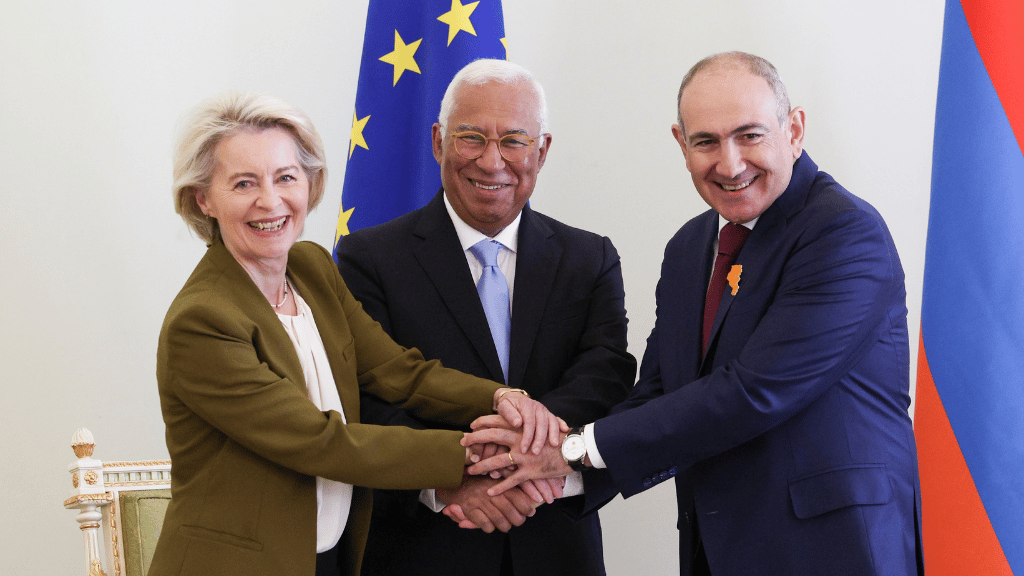
Three weeks after historic EU-Armenia summit in Yerevan, Brussels plots the path to membership
Three weeks after the first-ever EU-Armenia summit, held in Yerevan on 4 and 5 May 2026, the European Union institutions are taking stock of one of the most significant geopolitical openings on the EU’s external policy agenda this year. The summit, which followed the 8th European Political Community meeting on 4 May, has marked Armenia’s most decisive pivot toward European institutional space since the country adopted its EU Integration Act in 2025.
The summit protagonists
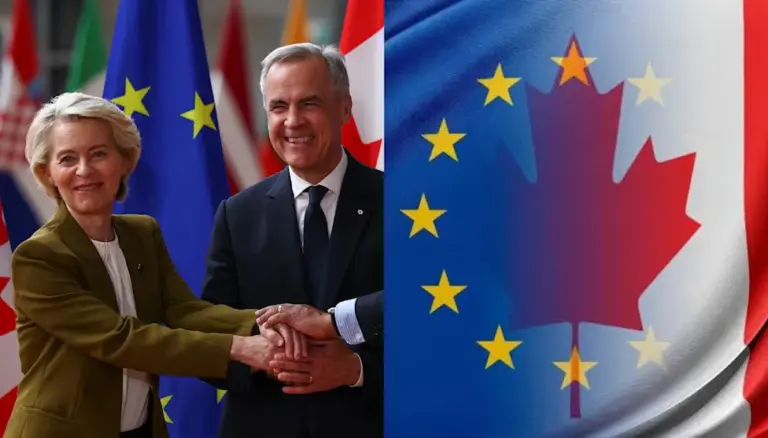
At the historic summit, the EU was represented by European Council President António Costa and European Commission President Ursula von der Leyen. Armenia was represented by Prime Minister Nikol Pashinyan. The visit confirmed the increasing dynamism of the bilateral partnership over recent years and built on the meetings of 14 July 2025 in Brussels, when Costa and von der Leyen had reaffirmed Armenia’s deepening partnership with the European Union.
Connectivity-focused strategic agenda
The EU-Armenia summit focused on strengthening bilateral relations, with particular attention to connectivity across three key domains: energy, transport and digital infrastructure. Leaders also discussed progress on ensuring peace, security, connectivity and prosperity in the South Caucasus, as well as current global challenges — notably the latest developments in the Middle East conflict and Russia’s continuing war against Ukraine.
Armenia’s coming EU membership application
On 18 October 2025, Armenian Foreign Minister Ararat Mirzoyan announced that Armenia would apply for EU membership either in November 2025 or in 2026. The May 2026 summit accelerated internal preparations in Yerevan for the application, with technical experts from DG NEAR engaging directly with Armenian institutions on alignment with the acquis communautaire. A formal application is now expected by late 2026.
Von der Leyen: “Shoulder to shoulder with Armenia”
In her remarks following the 14 July 2025 meeting in Brussels, Commission President von der Leyen welcomed Armenia’s adoption of the EU Integration Act, stating “Europe stands shoulder to shoulder with Armenia. European and Armenian relations are now closer than ever before.” This positioning was reinforced at the May 2026 Yerevan summit, with concrete commitments on investment, infrastructure and political support.
Armenia-Azerbaijan peace treaty
In August 2025, the EU welcomed the initialling of the Armenia-Azerbaijan peace treaty and the signing of a political declaration. The agreement between Armenia and Azerbaijan marked a significant breakthrough toward ending decades of conflict over Nagorno-Karabakh. The Union has stated its readiness to help develop inclusive regional connectivity through investment and the full opening of communications in the region, in support of sustainable peace and stability.
Strategic Agenda of 2 December 2025
On 2 December 2025, the European Union and the Republic of Armenia adopted a new Strategic Agenda providing the political framework for the deepening partnership. This document, together with the EU-Armenia Partnership Agreement signed in November 2017 and in force since March 2021, forms the legal architecture of the relationship — a base from which negotiations on accession could realistically advance.
Geopolitical stakes in the South Caucasus
Armenia’s EU pivot is one of the most significant shifts in the South Caucasus geopolitical equilibrium in decades. The country remains formally a member of the Russia-led Collective Security Treaty Organisation (CSTO), although Yerevan has effectively suspended its participation. Armenia’s decision to apply for EU membership, even on a symbolic level, marks a fundamental reorientation of its foreign policy — and is closely watched by Moscow, Tehran and Ankara as a major regional realignment.
Practical challenges on the path forward
Armenia faces structural challenges on its European path: a small economy, geographic isolation, governance gaps, judicial reform needs, and the political complexity of maintaining a working relationship with Russia while integrating into EU structures. The Commission’s response, building on lessons learned from Moldova and Georgia, is expected to emphasise sequenced and conditional support, tied to verifiable reform benchmarks. If the formal application arrives by year-end, the Commission’s opinion on Armenia’s readiness for accession negotiations should follow within 12 to 24 months — a timetable that places Yerevan on a credible, if demanding, European trajectory.